

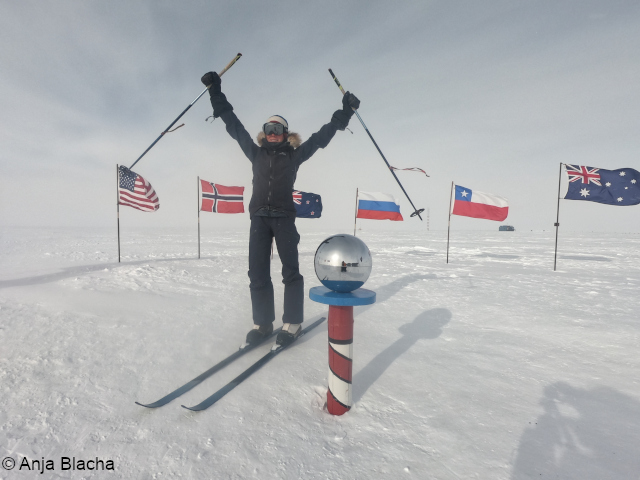
She is a strong woman. Anja Blacha reached the South Pole on skis, solo and without support. And she has already summited twelve of the 14 eight-thousanders, more than any other woman from Germany – and all of them without bottled oxygen.
The 35-year-old has even stood on Mount Everest three times: in 2017 via the Tibetan north side, with a breathing mask, in 2021 and 2025 from the Nepalese south side of the mountain, the first time with bottled oxygen from an altitude of around 8,400 meters, and four years later without a breathing mask – the first German woman to do so, by the way.
Before the start of this year’s spring climbing season in the Himalayas, Anja Blacha answered my questions.
Anja, you have climbed twelve of the 14 eight-thousanders without bottled oxygen. What dominates – pride in what you have already achieved or the ambition to now complete the collection?
I like to look ahead, carried by what lies behind me and has brought me to where I am today. I would question whether this needs to be described with the word “ambition,” which has rather negative connotations in German. Instead, I prefer to say: It’s great that there are goals and experiences I can look forward to and work towards. Those I have already achieved have been so enriching that I want to devote even more of my life to this path.
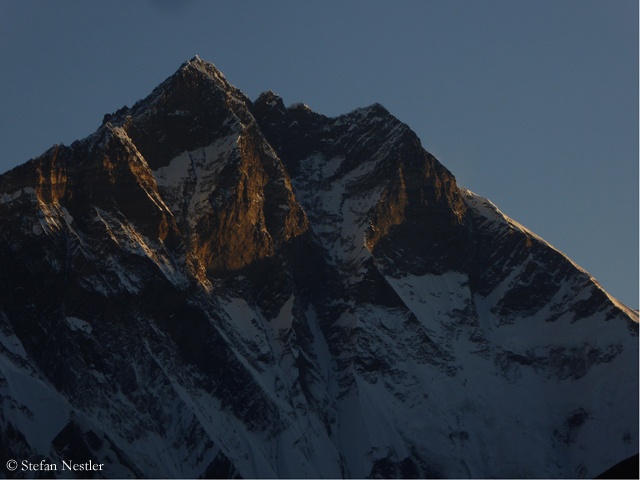
Lhotse and Shishapangma are still missing. Which of the two mountains do you see as the greater challenge for yourself?
A lot can happen on both mountains, whether it’s ice falling on the way to Lhotse or the danger of avalanches on Shishapangma. The current conditions and my own physical condition are important factors that I can’t assess in advance. But the biggest challenge is probably getting to the starting line.
How do you train for the eight-thousanders?
Every previous expedition is the best training for the next one.
You climbed your first eight-thousander -Everest with a breathing mask – in 2017. How do you think you have developed as a mountaineer over the past nine years?
I thought I had left the development talks from my working life behind me for the time being. 😊My obvious stages of development on the 8,000ers are:
- With Sherpa support and bottled oxygen
- With Sherpa support and without bottled oxygen
- Without Sherpa support and without bottled oxygen – or what many euphemistically refer to as a “solo expedition in alpine style.”

The less obvious ones are those that concern my role in the expedition I am involved in. These include elements such as designing the climbing strategy, mutual support on the mountain, and even handling critical moments.
Despite all the infrastructure, high-altitude mountaineering remains a risky sport. When was the closest you came to disaster?
Being caught in an avalanche on Annapurna was the most dangerous situation I’ve ever been in. In the mountains, you experience the dominance of the forces of nature like nowhere else.
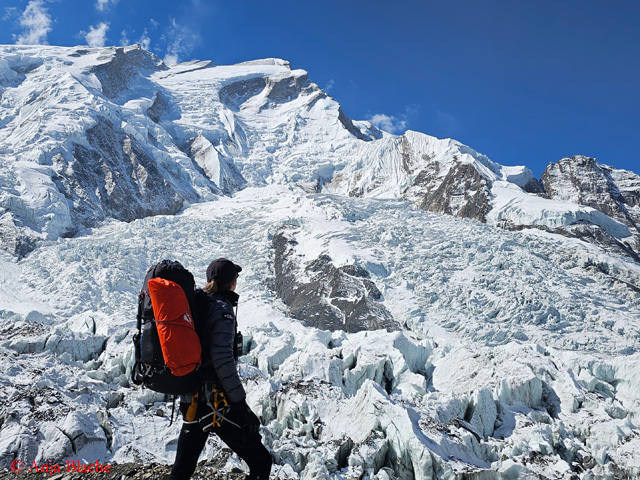
I have to consciously decide again and again what risks I am willing to take, what I want to spend my life on and what I don’t.
Who thinks about the accident statistics for their chosen route when driving, or considers how many years of their life they are taking away from themselves with their lifestyle when they are relaxing on the sofa with a bag of chips, and whether it is worth it?
In your opinion, how has mountaineering on eight-thousanders developed?

High-altitude mountaineering has become more professional in recent years. This includes not only an understanding of routes, weather, etc., but also cross-team cooperation, as promoted by the EOA-Nepal (Expedition Operators Association Nepal), for example.
The more and better coordinated manpower there is on the mountain, the more everyone benefits. The continuously growing interest in climbing eight-thousanders is what makes this development possible in the first place.
At the same time, Sherpas are becoming increasingly skilled technical mountaineers, undergoing training and further education, pursuing their own mountaineering goals, or founding expedition agencies; in Pakistan, this development is starting later.
It’s funny when Sherpas of this “new generation” point to Sherpas of the “old guard” – for example, when they are carrying heavy loads – and say: “Look, those are real Sherpas.”
The understanding of what constitutes Sherpa support has shifted, i.e., what is expected of a Sherpa as standard. In extreme cases, I have seen a female mountaineer who did not even carry her own ice axe on summit day, and others who were pulled up on a short rope when they did not have the strength or ability to make the next passage.
Of course, this does not apply to everyone, and there are also strong and independent mountaineers on the eight-thousanders. Similarly, mountaineers have climbed the summits with maximum support in the past. It’s just that, in my observation, significantly more support is considered normal than in the past. And in the past, even more details could be gleaned from the stories brought home.

The camp infrastructure is continuing to decline. Increasingly, the highest camp is no longer being set up, and even further down the mountain, individual camps are being skipped wherever possible.
This is driven in particular by the fact that, firstly, the expedition time can be reduced by using bottled oxygen earlier and more frequently instead of undergoing a long acclimatization process. Secondly, the loads to be carried up the mountain are still lower overall than if more camps and more rotations have to be supplied, despite the additional bottled oxygen. And thirdly, risk exposure is reduced when fewer rotations are made. The downside is the longer stages that have to be covered – especially the summit stage.
There are an increasing number of mountaineers who climb the maximum number of mountains that can be reasonably achieved in a year. Depending on their ambitions and goals, climbing the 14 eight-thousanders is now less of a lifelong project and more of a project that can be completed in one to three years.
Alternatively, there are Sherpa-assisted first ascents of smaller mountains or other routes, as well as mountaineers who tackle their own challenging projects on the eight-thousanders.
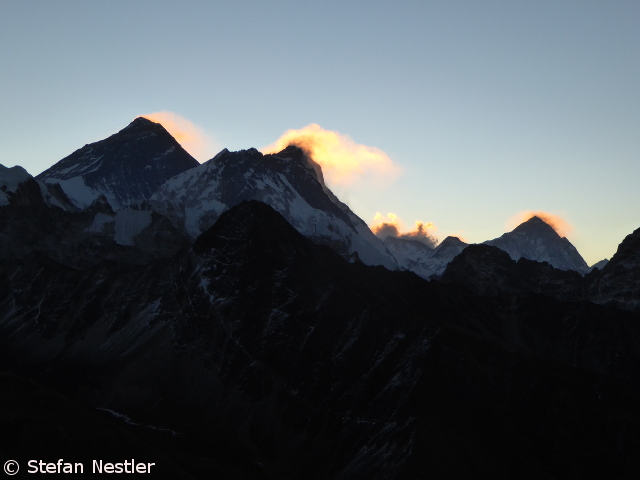
Expeditions also benefit from technological developments. For example, drones are used to search for missing persons or to scout routes through icefalls. Cargo drones have recently been used on Everest to transport ropes for fixing across the icefall and to carry collected rubbish down the mountain.
The issue of rubbish is becoming increasingly important and, in terms of quantity, is becoming more and more critical simply due to its accumulation over the years. Expeditions on many mountains are now required not only to take their own trash down with them, but also to remove the legacy of previous years. Unfortunately, this is not yet entirely successful.
Finally, there are the helicopter flights to consider. The extent to which their use has increased is probably most clearly reflected in insurance premiums. I have increasingly observed that mountaineers are only half-heartedly planning their descent. A helicopter from Camp 2 or 3 back to base camp is more comfortable and safer. No one strictly monitors this anyway; only the Himalayan Database adds a corresponding note when they become aware of helicopter use.
As much as the highly qualified and available helicopter pilots are an asset in real emergencies, they also encourage mountaineers to take greater risks, overestimate their abilities, or seek convenience. Accordingly, I have mixed feelings about developments in Pakistan, where helicopter rescues are to be carried out much more cheaply and with better pilots and helicopters in the future.
You’ve always been en route with commercial tour operators. Don’t you ever feel the urge to set off completely on your own?
First, I would need to better understand how commercial mountaineering differs from other types of mountaineering. I can’t find a conclusive answer to this in your blog. If I have base camp support and use fixed ropes, I am described as part of a commercial team. If someone else is climbing in this setup, they are sometimes described as distinct from commercial teams, to give just one example.

In any case, I can say that I approach projects in a way that is right for me personally at the time and thus at least meets my own standards.
For me, it is particularly important in this barely regulated, high-risk sport to make decisions based on my own performance and willingness to take risks. An ambitious project can end fatally all too quickly – it’s a shame if the primary motivation was to live up to external expectations.
Unlike other sports, where particularly risky exercises are prohibited in order to protect athletes from the urge to perform at their best at any cost, such rules practically do not exist in mountaineering. Personal responsibility comes first.
Your South Pole expedition at the turn of 2019/20 was themed “Not bad for a girl.” High-altitude mountaineering was also long considered a macho sport. How do you experience that?
Women are still in the minority, but their share is increasing, which I find a welcome development. They bring their own unique qualifications to the table, which benefit them on the mountain and enrich the teams.
Can you still walk down the street unrecognized?
Absolutely, and as much as my last years have been spent in and with the mountains, my identity as a person does not depend on the mountains. That’s a degree of freedom that I like to maintain.
Do you already have an idea of what might come next once you’ve completed the final chapter of your eight-thousander climb?
I find it interesting that the question “What’s next?” is practically always asked, but at the same time – at least in other media – people tend to get worked up about “announcement alpinism.”
I’m currently still in the process of climbing the 14 eight-thousanders. Whether and when I’ll be able to complete this project is still open.
I’m not worried about getting bored. Even now, I only spend part of the year on expeditions. In fact, my experience is that the more I see and learn about the world, the more exciting topics and goals I discover. In a sense, every summit is a vantage point and sometimes a springboard to new horizons.