
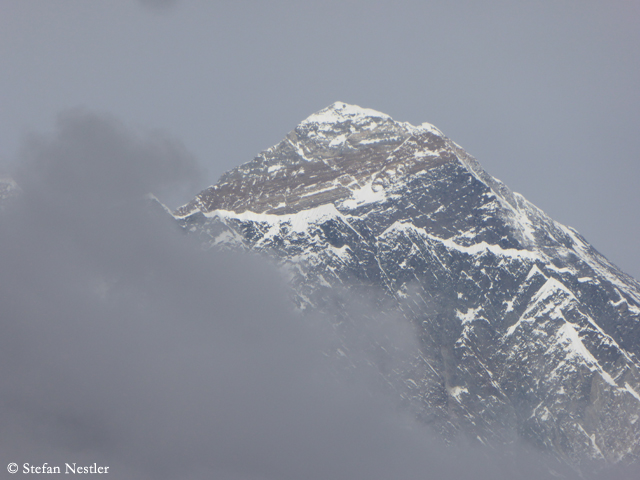
Calm is returning to Mount Everest. The Icefall Doctors are bringing the aluminum ladders they used to span large crevasses along the route through the Khumbu Icefall back to the depots in the village of Gorak Shep. Staff from the Sagarmatha Pollution Control Committee are sorting through the trash at base camp, which is to be transported down the mountain from there.
More permits and ascents than ever before
Once again, Mount Everest has proven to be a lucrative business model. The cash registers were ringing. Never before has the Nepalese Tourism Department sold so many climbing permits for the world’s highest mountain: 495. And this despite the fact that, for the first time this spring season, the price was set at $15,000 per foreign climber, up from the previous $11,000. The permits alone brought in more than seven million U.S. dollars to the state treasury.
Since the weather in the second half of May was more stable than some meteorologists had predicted, there were more successful Everest ascents than ever before – even though the Chinese-Tibetan authorities had closed the mountain on the Tibetan north side to foreign teams. For the first time, the milestone of 1,000 summit successes was surpassed.
More than 14,700 Everest ascents since 1953
Khimlal Gautam, coordinator of the Tourism Department’s temporary office at Everest Base Camp, told the Nepalese website Ekantipur that as of Friday morning (29 May), 1,008 people had reached the highest point on earth this spring. A few days earlier, in light of the large number of people on the mountain, Gautam had stated: “This situation has clearly shown us the need to think from a new perspective on climbing Everest.”

Gautam had climbed Everest himself in 2011 and 2019. On his second ascent, he served as the Nepalese chief surveyor tasked with determining the exact height of Mount Everest. Scientists from China and Nepal subsequently announced that the mountain was 8,848.86 meters high.
With the ascents of the spring season that has now come to an end, the number of successful summits since the first ascent by New Zealander Edmund Hillary and Nepalese Tenzing Norgay on 29 May 1953 has risen to over 14,700. This makes it by far the most frequently climbed eight-thousander.
In May 2024, the Supreme Court of Nepal ordered the government to limit the number of permits for environmental reasons. The court stated at the time that the mountains’ limited capacity must be “respected.” The court did not provide any further specifics – thus leaving all loopholes open. And so, to this day, there is no cap on permits. Commercial mountaineering on Everest is a well-oiled money-making machine.
Nirmal Purja and Nikol Kovalchuk on top of Everest without breathing masks

In the final days of the season, there were two more successful Everest summits without bottled oxygen. Nirmal Purja, head of the operator Elite Exped, reached the summit without an oxygen mask, as did his Russian client Nikol Kovalchuk. They were part of a 27-person team at the summit; the other 25 used bottled oxygen.
Purja went on to climb the 8,516-meter-high Lhotse. According to his own account, he stood – still without a breathing mask – on the highest point of the world’s fourth-highest mountain 13 hours and 42 minutes after his Everest summit success.
Nepalese Climber Missing
There may be a sixth fatality to mourne this season. According to information from the Nepalese website The Tourism Times, Dawa Sherpa, a Nepalese climber working for the operator Himalayan Traverse, fell behind while descending the Lhotse flank on Friday evening local time. He has not yet arrived at Camp 2 at 6,400 meters, the company’s director – who is also named Dawa Sherpa – reported. No rescue operation was launched because the ladders in the Khumbu Icefall had already been removed, he told The Tourism Times.
It remains unclear why a helicopter was not deployed to search for the missing climber. Some members of commercial teams were flown on Sunday by helicopter from Camp 2 to base camp.