
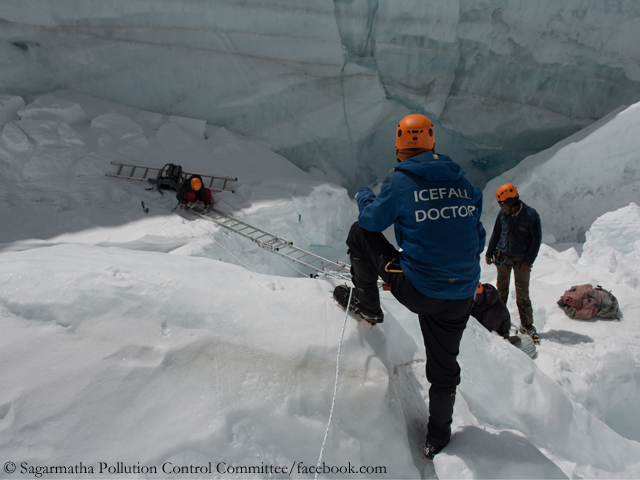
The difficult conditions on Mount Everest have now even prompted the Nepalese government to take action. The Ministry of Tourism authorized the Expedition Operators Association of Nepal (EOAN) to “to mobilize skilled human resources available through its affiliated agencies” to assist the Icefall Doctors in their work on the lower sections of the routes on Everest, Lhotse, and Nuptse.
Dangerous serac threatens the route
The reason for the government’s unusual intervention is that the route from base camp to Camp 2 at 6,400 meters has still not been cleared. The Icefall Doctors had suspended their work because they wanted to wait until a fragile serac hanging over the route collapsed.

According to Tshering Tenzing Sherpa, base camp manager of the Sagarmatha Pollution Control Committee (SPCC), part of the serac has meanwhile broken off. The Icefall Doctors expect the rest to collapse within a few days, allowing them to resume their work.
Schedule is falling behind
Since 1997, the SPCC has typically been solely responsible, on behalf of the Nepalese government, for the route through the Khumbu Icefall up to Camp 2. Only above that point – that is, above 6,400 meters -has the EOAN previously ensured that one of its agencies fixed the ropes to the summit. Now, according to the government’s wishes, the two organizations are to join forces to make faster progress.
Only once the Icefall Doctors give the green light can commercial teams send their paying clients and their guides to the Western Cwm – the valley above the Khumbu Icefall – to continue acclimatizing there.
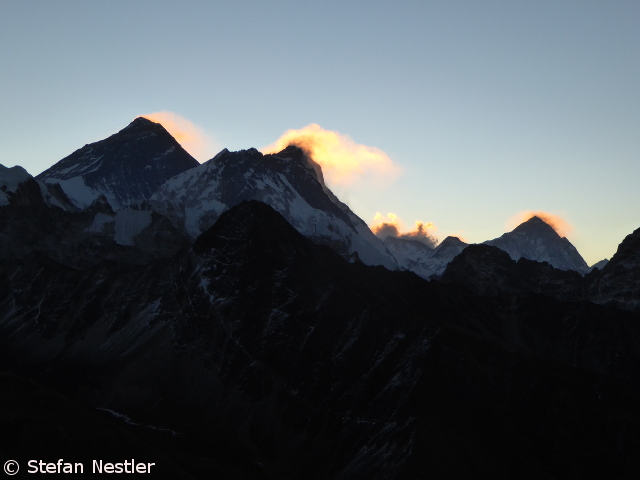
Normally, these so-called “rotations” are already underway at this time of year. Consequently, expedition operators are anxious that time is running out and that, by the end of May, they may be left with only a single brief window of good weather for their summit attempts. The result would likely be congestion on the route up to the highest point at 8,849 meters.
410 Everest permits so far
As of 23 April, the Nepalese Ministry of Tourism has issued 410 Everest permits to foreign climbers. During the 2025 spring season, the government had issued 468 permits for the world’s highest mountain. The second-highest number of permits for eight-thousanders this season is for Lhotse (86), followed by Makalu (54), Kangchenjunga (34), and Dhaulagiri (30).
More summit successes on Makalu and Dhaulagiri
A few more summit successes were reported today from Makalu and Dhaulagiri by guides and their clients. On both mountains, the rope-fixing teams had secured the route to the summits last weekend.
Update 25 April: According to initial reports, Domi Trastoy Diaz summited Dhaulagiri yesterday without bottled oxygen. This was Domi’s eighth eight-thousander. The 45-year-old mountaineer from Andorra reportedly took part in a rescue operation during the descent to assist a Sherpa who had broken his leg.