

His expertise and his voice will be missed. As his family announced yesterday on Facebook, Michael Beek died “after a sudden and serious illness.” Beek was considered the preeminent German-speaking expert on Pakistan’s mountain regions. Few Westerners are likely to have known the mountains in the north of the country as well as he did. Beek loved the region, the people there, and their culture.
Born in 1955 in the small town of Solingen in North Rhine-Westphalia and raised in Wuppertal, the German spent several months a year in Pakistan for more than forty years, with few exceptions. On three occasions – in 1981, 1983, and 2001 -expeditions took him to the Rupal Face of the 8,125-meter-high Nanga Parbat, each time via the so-called Schell Route. In 1983 and 2001, Michael led the expeditions. The highest point he reached was Camp 3 on the Southwest Ridge at around 7,100 meters.
Trekking pioneer
Beek became better known, however, for his trekking adventures. He crossed the Karakoram a total of five times, sometimes on routes that no one had ever taken before him. In 1985, he and a small group circumnavigated Nanga Parbat for the first time via the Mazeno Pass; today, the trek is considered one of Pakistan’s classic treks.

In 1992, Beek flew along the South Face of Nanga Parbat with a paraglider. The first edition of his Pakistan trekking guidebook in German language was published in 1996. It is probably not missing from any bookshelf of adventure travelers from the German-speaking world who have been or are drawn to Pakistan – myself included. Until the very end, Beek led trekking groups through Pakistan’s fascinating mountain world for the German tour operator Hauser Exkursionen.
Fighter for sustainable mountain tourism
He advocated for sustainable mountain tourism and warned against repeating in Pakistan the same mistakes made in the European Alps or even in Nepal. The increasing pollution in the region around Nanga Parbat – the “mountain that has dominated my life since 1981” – made him “very sad,” Michael lamented on Facebook in 2022.
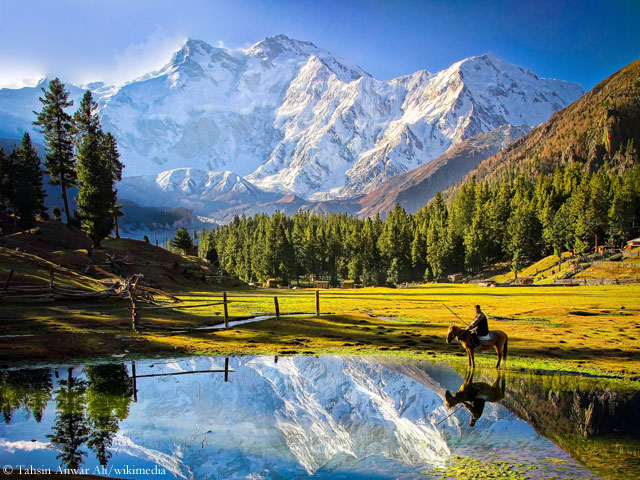
The problem isn’t limited to Nanga Parbat, he wrote to me at the time: “What’s been happening in the Karakoram in recent years is hard to bear. If the government doesn’t intervene, this reckless behavior will continue. Nanga Parbat, the Fairy Meadows (at the foot of this eight-thousander), Concordia (glacier junction near K2), and Karimabad (a town in the Hunza Valley) have become hotspots. If the government doesn’t take action soon, more and more will be destroyed, and then there will be no turning back.”
“Legend of the Karakoram”
In Pakistan, Beek had countless friends and enjoyed a reputation as a “tourism ambassador” for the country, even though he was never officially one. The locals greatly admired his love for the country’s mountains, which he had nurtured for nearly 45 years.

“Michael was a true pioneer. He explored and documented remote routes that had rarely, if ever, been traveled before,” wrote Nasir Hussain of the Pakistan Association of Tour Operators (PATO) in an obituary for Beek, whom he called a “legend of the Karakoram”: “His legacy will live on in every trail he pioneered, every expedition he led, and in the hearts of all who had the privilege of walking the mountains with him.”