

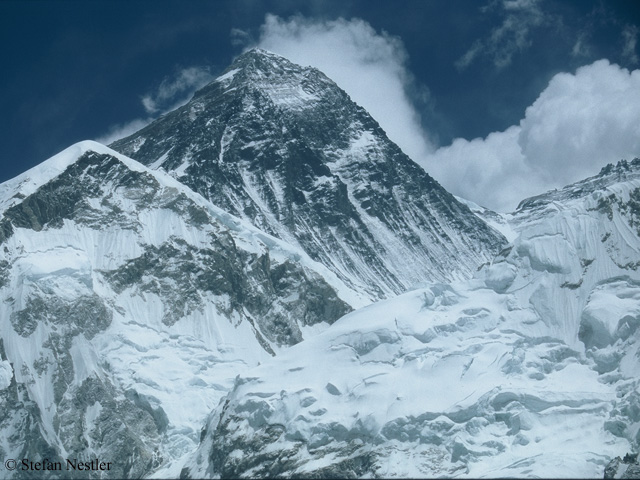
Thanks to a joint effort, the route up to the summit of Mount Everest at 8,849 meters has been secured. This morning local time, a twelve-member Nepalese rope-fixing team led by Mingtemba Sherpa reached the “Roof of the World.” It was the first summit success of this year’s spring season on the world’s highest mountain.
Following in the very fresh footsteps of the rope-fixing team, the first group from a commercial expedition operator also reached the summit. Ten Sherpas were at the top with six clients, Imagine Nepal reported. Its leader, Mingma Gyalje Sherpa, had worked with the leaders of other major Nepalese operators to speed up the process so that the route to the summit could be secured as quickly as possible.
Hundreds in the starting blocks
“We did not want to take the lead, but we cannot miss this summit weather window,” Mingma Gyalje wrote yesterday on Instagram after Nepalese climbers from his and two other companies had fixed the ropes to just above the so-called “Balcony” at around 8,400 meters.
This spring, the Nepalese Tourism Department issued permits for Everest to 492 foreign climbers – more than ever before. Against this backdrop, traffic jams on the route are almost inevitable. A preview of this was provided by the long line of Nepalese climbers on the Lhotse flank, who have been carrying gear up to the South Col in recent days.
Ziemski completes Lhotse ski descent after ascent without a breathing mask
Already yesterday, Tuesday, Polish ski mountaineer Bartek Ziemski had reached the summit of the 8,516-meter-high Lhotse – setting out solo from Camp 4 at 7,850 meters, without bottled oxygen and without fixed ropes on the final stretch to the summit. He then skied the entire route back down to base camp, according to his own account – with the exception of a large crevasse in the Khumbu Icefall, which he crossed using a ladder installed by the Icefall Doctors.

The conditions were “only for experts,” Ziemski said, according to the Polish Mountaineering Association: rock-hard ice, fresh snow, and wind-swept passages. A combination that did not allow him to lose concentration for even a moment.
And a permit for Everest as well
For the 30-year-old, this was already the eighth eight-thousander he had skied down after climbing it without bottled oxygen. He had previously achieved this feat in 2022 on Broad Peak and Gasherbrum II in Pakistan, in 2023 on Annapurna I and Dhaulagiri, in 2024 on Makalu and Kangchenjunga, and in 2025 on Manaslu.
There may even be another attempt this spring season – as Ziemski also holds a climbing permit for Mount Everest.
Two Czechs on the summit of Makalu II
According to the Nepalese operator IAM Trekking & Expeditions, the two Czechs Martin Ksandr and Petr Kadanka successfully climbed the 7,678-meter-high Makalu II, also known as Kangchungtse, today in alpine style – that is, without oxygen masks, without Sherpa support, without fixed ropes, and without fixed camps. Last week, their teammate David Roubinek died at an altitude of 7,350 meters, presumably from high-altitude pulmonary edema.
Göttler and Haley presumably open new route on Langshisha Ri

Meanwhile, top German mountaineer David Göttler and his climbing partner Colin Haley from the U.S. likely opened a new route to the summit ridge in alpine style on the 6,427-meter-high Langshisha Ri in Langtang National Park.
“We’ve been trying to find out if this line has been climbed before but so far it doesn’t appear so,” David writes. “But if anyone knows of a previous ascent please let us know.”
According to their own accounts, Göttler and Haley took eleven hours to make the ascent and seven hours to descend on the same day.