
This is the first fatality of this year’s spring season on Mount Everest – even though the accident occurred below base camp. According to Nepalese media reports, Lakpa Dendi Sherpa fell and died last Sunday while hiking from Gorak Shep, the last inhabited settlement in the Everest valley, to base camp.
The 51-year-old Nepalese guide was reportedly leading an Everest expedition group for the Indo-Tibetan Border Police. The exact circumstances of the accident remain unclear. The final stage of the trek to Everest Base Camp crosses the moraines of the Khumbu Glacier and is considered neither technically demanding nor particularly dangerous.
Six ascents of Makalu
Lakpa Dendi, who hailed from the small village of Gudel in Solukhumbu, situated at an altitude of around 2,000 meters, was an experienced mountaineer. According to the Himalayan Database, the Sherpa, who worked for the operator Seven Summit Treks, stood on the summit of the 8,485-meter-high Makalu a total of six times between 2008 and 2025.

In 2016, he climbed the 8,163-meter-high Manaslu – not the so-called True Summit, but a slightly lower point further forward on the summit ridge, which was common practice among commercial teams at the time. In 2017, Lakpa Dendi also stood on the “Roof of the World,” the summit of Mount Everest at 8,849 meters. His life now came to an abrupt end at the foot of the world’s highest mountain.
Czech Climber apparently dies of HAPE

There was another fatality on nearby Makalu II. This secondary peak of the 8,485-meter-high Makalu, also known as Kangchungtse, stands at 7,678 meters and was first climbed in 1954.
According to Czech media reports, David Roubinek, a member of a Czech expedition to Makalu I and II, died during the descent at an altitude of 7,350 meters – presumably from high-altitude pulmonary edema (HAPE).
The ten-member expedition group had previously split up: four were heading for the main summit of Makalu, and six, including Roubinek, for Makalu II. It was reported that the 38-year-old began showing symptoms of life-threatening high altitude sickness at Camp 3, at around 7,400 meters.
“Our team was right there on the spot and did everything in its power to save him, but despite administering oxygen and other medications, we could no longer help him,” the expedition team announced on Facebook.
Two injured in the Khumbu Icefall
By contrast, an incident in the Khumbu Icefall ended relatively well. Two climbers were caught in a small avalanche below Camp 1 (6,100 meters) but could be rescued from the ice. The two, who sustained minor injuries, were flown out by a rescue helicopter.
The Sagarmatha Pollution Control Committee (SPCC), which deploys the Icefall Doctors every year, has pointed out that the route to Camp 2, which opened last week, is not safe. The reason: a massive ice tower, 55 meters long, 28 meters high, and 37 meters wide, hangs over the route like the sword of Damocles. “The serac has multiple cracks and may collapse at any time,” warns the SPCC.
Favorable Conditions Expected
The rope-fixing team securing the route in the upper section of the mountain is expected shortly at the South Col, at around 8,000 meters, the last campsite before the summit. For the coming days, meteorologists are forecasting relatively little wind in the summit zone.
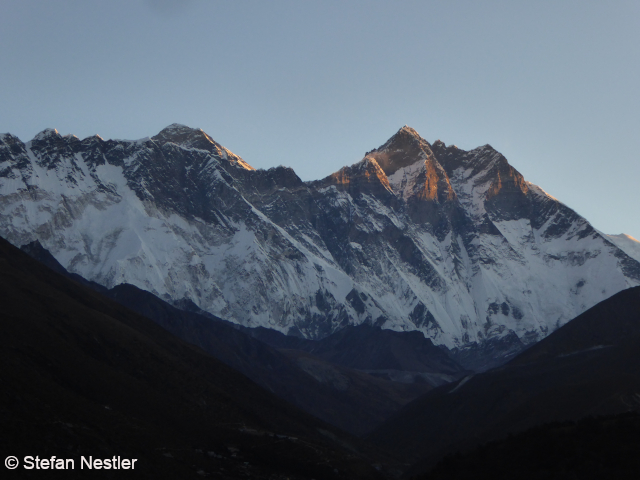
This spring (as of 5 May), the Nepalese Tourism Department issued 464 Everest climbing permits to foreign climbers, as well as 111 permits for neighboring Lhotse, the world’s fourth-highest mountain at 8,516 meters.
Among the climbers attempting to summit Lhotse is German mountaineer Anja Blacha. The 35-year-old plans to climb the mountain without bottled oxygen. If she succeeds, it would be her 13th eight-thousander without a breathing mask. Then the only eight-thousander missing from Anja’s collection would be the 8,027-meter-high Shishapangma in Tibet. This spring, the Chinese-Tibetan authorities did not allow any foreign climbers into the country.